


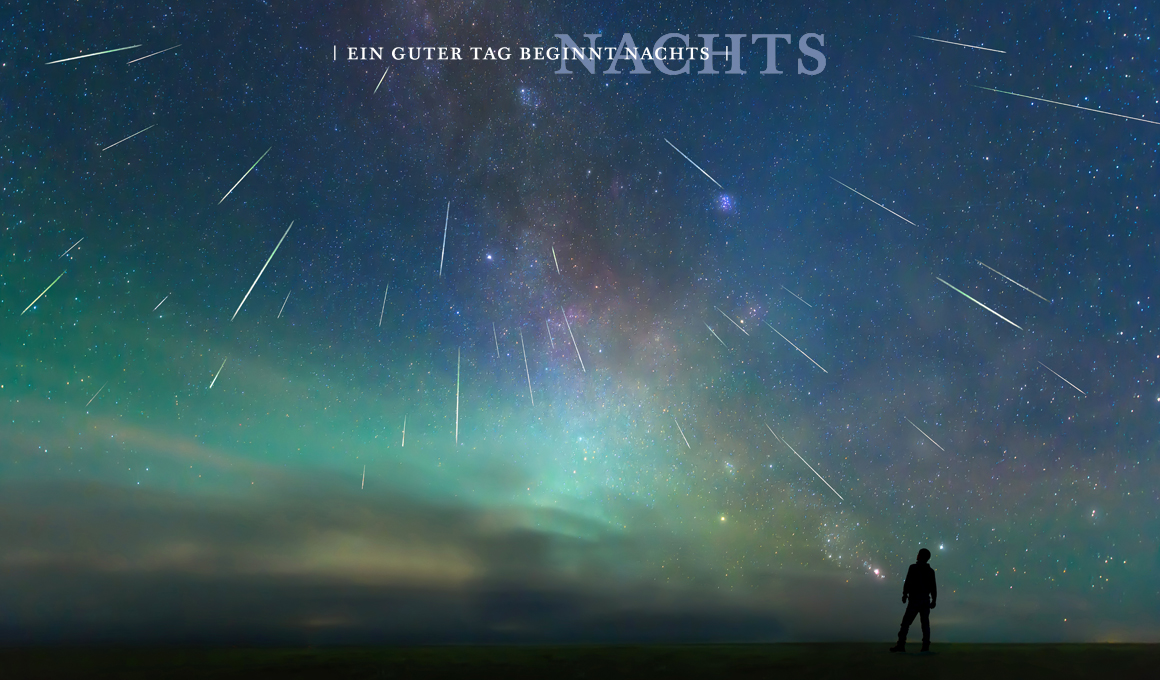
Shooting stars are one of the celestial phenomena that never cease to fascinate us – regardless of whether we discover a streak of light in the night sky by chance or observe them deliberately and in a planned manner.
Many people find these nights soothing because the silent observation under the dark sky calms us down and helps us to take a break from the day in the evening. This special atmosphere can even create a feeling of inner peace, which we often seek just before going to bed. In this article, we explain how shooting stars are formed, which showers are particularly active and what you should look out for during the Geminids.
What exactly are shooting stars?
Shooting stars are formed when tiny particles – in most cases dust or rock fragments from outer space – enter the Earth’s atmosphere and burn up. In astronomy, the resulting flash is known as a Meteor. U n common parlance, we simply speak of a shooting star.
The particles often originate from fine dust clouds that comets or asteroids lose in the course of their orbit. If the Earth encounters such an accumulation of dust particles on its orbit around the sun, this results in nights with a particularly large number of visible phenomena.
Depending on the density and composition of the dust, the brightness, speed and frequency can vary. While some shooting stars only appear as fine streaks of light and quickly disappear again, others are strikingly bright and even leave a short trail of light.
Why are there shooting star showers?
The Earth orbits the sun on the same path every year. In doing so, it regularly passes through regions of space in which the finest dust and rock particles – known as meteoroids – have been left behind as the remains of passing comets or asteroids. As soon as the Earth enters such a dust cloud, many of these particles burn up in the Earth’s atmosphere. The resulting visible glow in the night sky is known as a shooting star shower.
These showers are easy to predict because the dust clouds are in similar positions in space over long periods of time and the Earth passes through them at roughly the same time every year. This is why many well-known shooting star showers – such as the Perseids, Geminids or Lyrids – occur annually and with relatively constant activity.
Astronomically, a distinction is made between two types of shooting star phenomena:
Sporadic shooting stars that occur throughout the year and are not associated with any particular stream. They occur when individual particles hit the Earth’s atmosphere by chance.
Shooting star streams in which the Earth encounters dense accumulations of dust and rock particles in its orbit at fixed times of the year. If many of these particles enter the atmosphere in a short period of time, there are nights with a particularly large number of visible shooting stars.
It is these streams of shooting stars that cause the regular and easily observable light events and explain why certain periods of the year are considered particularly suitable for sky observations.
Geminids 2026 – when and where to see them best
The Geminid meteor shower is one of the most impressive events of the year. In 2026, it will be visible from 12 to 13 August 2026 with up to 100 meteors per hour. The peak activity is expected during the night of 13 to 14 December 2026. In particularly active years, over 150 shooting stars per hour have been recorded.
If the sky is clear, it is worth taking a look shortly after dark, but the best visibility is around midnight when the constellation Gemini is high in the sky.
The most important shooting star showers throughout the year
Quadrantids in January
Quadrantids are among the most prolific shooting star showers of all, but have a very short activity phase. Their maximum often lasts only a few hours. Due to the winter temperatures in many regions, they are observed less frequently, although they can reach impressive brightness levels.
Lyrids in April
The Lyrids are one of the oldest historically documented shooting star showers. Their activity is moderate, but there are always particularly bright light phenomena that can form so-called “fireballs”. They are a great start to the spring observation season.
Perseids in August
The Perseids are one of the best-known and most popular shooting star showers. They reach their annual peak in mid-August and often feature dozens of visible shooting stars per hour. Many meteors from this stream are particularly bright and fast. Due to the warm summer nights, the Perseids are ideal for longer observations under the open sky.
Draconids and Orionids in October
Both events fall in the early fall. The Draconids are relatively unpredictable and vary greatly in their intensity. In some years there are only a few meteors, while in other years there are surprisingly many and bright shooting stars.
The Orionids are considered constant and reliable. They are formed from the remnants of the material stream of the famous Halley’s Comet – or 1P/Halley, as it is officially known – and are characterized by fast, clearly visible streaks of light.
Geminids in December
The Geminids are among the most impressive shooting star showers of the year and reach their maximum every year in December. Their shooting stars often appear brighter and slower, which makes them easy to see. Because the event falls during the long winter nights, viewing conditions are often favorable – even if it can be cold. The Geminids are considered a very reliable and consistent stream of shooting stars.
All these annual streams make the observation of shooting stars predictable. At the same time, there are always nights outside of these showers when sporadic meteors appear in the sky – albeit with a much lower probability. In addition, there are numerous other, less pronounced shooting star showers that occur throughout the year, but usually show little activity and are therefore less likely to be consciously noticed.
Why do we associate shooting stars with wishes?
The origins of this belief go back a long way. In many cultures, shooting stars were regarded as rare and significant phenomena. They were often interpreted as heavenly signs – as a brief moment in which the sky opens up and wishes are given special power. This idea gave rise to the tradition of making a wish at the sight of a shooting star.
From a psychological point of view, wishing at shooting stars is above all a moment of conscious focus. You pause, focus your thoughts on a personal concern and link this moment with a positive experience. This small ritual act can create clarity and convey confidence. It is similar to the conscious introspection that many people experience on particularly dark nights, such as around the new moon.
If you would like to find out more about how the new moon can affect sleep, mood and inner peace, you can find more interesting information in our article New moon – influence, meaning and effect on our sleep.
Shooting star nights and their effect on us
A good view of shooting stars requires above all a sky with little light. Nights without strong moonlight – around the new moon, for example – also improve the conditions. The nocturnal environment also has a calming effect on our organism: melatonin levels rise and sensory stimuli decrease. Many people feel noticeably more relaxed in this environment.
Waiting quietly under the night sky also contributes to this. If you sit or lie down for a longer observation, look up at the sky and pause for a moment, you often experience a feeling of slowing down. This quiet, attentive observation can have a similarly beneficial effect as other evening rituals that contribute to inner peace.
In our article How do the individual phases of the moon affect our sleep? you can read how strongly light and darkness can influence our sleep.
Shooting star nights combine two aspects: They are a rare natural event and create an environment that promotes peace and regeneration. Many people see these nights as a special break from everyday life.
Five tips for observing shooting stars
If you want to see shooting stars as well as possible, you can significantly improve your viewing conditions with a few simple measures:
- As little light as possible: The best viewing conditions occur in places without artificial light sources and on nights with weak moonlight. Shooting stars are usually particularly visible around the new moon.
- Get your eyes used to the dark: After around 15 to 20 minutes, the eye’s sensitivity to light increases. Bright light – including smartphones – should be avoided during this time.
- Assume a comfortable position: A reclining position on a blanket or reclining chair makes it easier to look up at the sky and makes longer observations more pleasant.
- Keep an eye on the whole sky: Shooting stars usually appear spread over a larger area of the sky. You should therefore not just focus on a single point.
- Be patient: Even on nights with lots of shooting stars, it can take a few minutes for the first streaks of light to become visible.
For restful nights after stargazing
Those who return to bed after a long night of observation benefit from a peaceful, comfortable sleeping environment. Especially when sleep starts later or is a little shorter, the right bedding can help you wake up feeling relaxed and rested.
The LATEXI® neck support pillow adapts perfectly to the head and neck thanks to its soft yet supportive VITA-Talalay® latex core. Different waves and a removable insert plate allow individual height adjustment. The washable cotton cover is allergy-friendly and supports a pleasantly fresh lying sensation.
The COLINA® down duvet impresses with its high-quality mix of 90% new goose down and 10% goose feathers and offers particularly soft, even warmth. The fine cotton batiste is pleasantly smooth to the touch and reliably wicks away moisture – ideal for snuggling up in after a cool night outdoors.