

Many people go to bed tired at night, seem to get enough sleep – and still feel exhausted the next morning. Concentration is difficult, energy is lacking and even after several hours of sleep, there is no real recovery. Stress or a restless daily routine are often blamed for this. But sometimes the cause lies deeper, namely in sleep itself.
One possible explanation for this is so-called sleep apnoea, or sleep apnoea in medical terms. This involves repeated interruptions in breathing during the night, which often go unnoticed but can significantly impair sleep.
What is sleep apnea?
The term “apnea” comes from the Greek and means “not breathing”. This is exactly what happens with sleep apnea: Breathing repeatedly stops for short periods during sleep. These pauses in breathing can last a few seconds, but in some cases can last significantly longer and often occur several times an hour.
Medically, sleep apnea is classified as a sleep disorder, as it repeatedly interrupts the natural sleep cycle and impairs nightly rest. A basic distinction is made between two forms. The most common form is obstructive sleep apnea, also known as obstructive sleep apnea syndrome (OSAS). In this case, the upper airways are narrowed or blocked during sleep, temporarily interrupting the flow of air.
Central sleep apnoea, known as central sleep apnoea syndrome (ZSAS), occurs less frequently. In this case, the cause is not a narrowing of the airways, but a disturbed control of breathing in the brain.
The obstructive form plays a particularly important role in the everyday lives of most sufferers.
Snoring and sleep apnea – what’s the difference?
Snoring and sleep apnea are often confused or equated with each other. There is indeed a connection – but there is a crucial difference.
Snoring occurs when soft tissue parts – such as the soft palate or uvula – start to vibrate while the air we breathe passes through. In many cases, this is disturbing but not harmful to health. Sleep apnea, on the other hand, is characterized by repeated interruptions in breathing. These interrupt sleep again and again and can impair the body’s oxygen supply.
Not everyone who snores automatically suffers from sleep apnea. Conversely, however, many sufferers snore. If you would like to find out more about the causes and background, you can find more information in our article on snoring: Burden on health and partnership for more information.
Symptoms of sleep apnea – typical signs at night and during the day
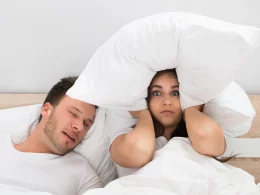
A particular characteristic of sleep apnea is that it often remains undetected for a long time. Many sufferers themselves do not notice that their breathing repeatedly stops during sleep. Instead, it is often their partners who notice irregular, loud snoring or short pauses in breathing.
The effects are not only felt at night, but especially during the day. Despite getting enough sleep, sufferers often feel tired, exhausted and less productive. The nightly breathing interruptions disrupt the natural sleep cycles so that the body does not get enough deep, restorative sleep phases.
Typical symptoms of sleep apnea are therefore persistent daytime tiredness, concentration problems and a general feeling of exhaustion. Morning headaches or the feeling of not really being well-rested can also be signs.
These complaints are often similar to other forms of sleep disorders in which night-time regeneration is also impaired. You can find a comprehensive overview of this topic in our article Sleep disorders – causes and the best tips.
A typical characteristic of sleep apnea is that the tiredness does not improve even after supposedly quiet nights. In such cases, it is worth taking a closer look at your own sleep quality. After all, it is not always the duration of sleep that is decisive, but how restful the sleep actually is.
Causes of sleep apnea – how breathing stops occur
The most common cause of this sleep disorder is a narrowing of the upper airways. During sleep, the muscles in the throat relax. In some people, this natural relaxation causes the airways to narrow or temporarily close completely. This reduces or interrupts the flow of air, resulting in the typical cessation of breathing.
This process is facilitated by various factors. Being overweight can increase the pressure on the airways and further constrict them. Anatomical features in the area of the jaw, tongue or nose can also play a role, as they reduce the space available for breathing.
Alcohol or certain medications also have a negative effect, as they further reduce muscle tension. This causes the airways to become more relaxed, which increases the risk of breathing interruptions during sleep.
With increasing age, the tissue in the throat area loses its elasticity, which can also increase the likelihood of sleep apnea. The causes are therefore varied and it is often not a single trigger, but the interaction of several factors that contributes to the development.
How dangerous is sleep apnea?
Sleep is a key requirement for our physical and mental regeneration. During the night, our body goes through various sleep phases in which important recovery and repair processes take place. If this natural process is repeatedly interrupted, it can have long-term consequences.
With sleep apnoea, the repeated pauses in breathing cause the body to repeatedly go into a kind of alarm state. Breathing stops and the oxygen level in the blood drops. The brain then reacts with short wake-up reactions to get breathing going again. These interruptions usually remain unconscious, but prevent deep, restful sleep.
The result is fragmented sleep in which important deep sleep phases are reached less frequently. Nocturnal regeneration remains incomplete – even if the sleep duration appears to be sufficient.
In the long term, this can not only affect your general well-being, but also your health. Studies show links between sleep apnea and high blood pressure, cardiovascular diseases and metabolic disorders. Against this background, sleep apnea should not be underestimated.
Diagnosis and treatment of sleep apnea
If there are signs of sleep apnea, it is advisable to seek medical advice. Initial indications can be obtained using simple measuring devices that record breathing and oxygen saturation during the night, for example. For a precise diagnosis, an examination is often carried out in a sleep laboratory.
There, various bodily functions such as breathing, heart rate and sleep phases are analyzed in detail. This makes it possible to determine whether and to what extent breathing interruptions occur and to what extent sleep is impaired as a result.
Treatment depends on the cause and severity of the sleep apnea. In many cases, so-called CPAP therapy (Continuous Positive Airway Pressure) is used. This involves using a breathing mask to create a slight positive pressure, which keeps the airways open and thus prevents breathing stops at night.
Depending on the individual situation, other measures may also be useful. These include, for example, special dental splints that stabilize the lower jaw or lifestyle changes such as weight reduction or abstaining from alcohol in the evening. Which therapy is suitable in each individual case should always be decided together with medical professionals.
What can you do to improve your sleep?
The measures that can help with sleep apnea depend on the cause and severity. In many cases, medical treatment is necessary, but there are various factors that sufferers can positively influence themselves. Small changes in everyday life can help to improve the overall quality of sleep and reduce night-time stress.
Good sleep hygiene is an important foundation. Regular sleeping times, a quiet and preferably dark bedroom and fixed evening routines help the body to adjust to the night. Avoiding alcohol or heavy meals in the late evening can also have a positive effect, as both can further relax the muscles and encourage breathing stops.
The sleeping position also plays a decisive role. In the supine position, there is an increased likelihood of the tongue falling backwards and narrowing the airways. A stable side position can often provide noticeable relief here.
It can also be useful to take a look at your own lifestyle. Sufficient exercise, a balanced body weight and a conscious approach to stress not only support general health, but often also have a positive effect on sleep.
It is also important to understand that disturbed sleep cannot simply be “made up for”. If you would like to find out more about this, you can find more information in our article Catching up on sleep – how useful is it really?
The right sleeping environment as the basis for restful sleep
Regardless of the cause, a pleasant and supportive sleeping environment is an important basis for good sleep. Although it cannot cure sleep apnea, it can help to improve overall recovery at night.
A balanced sleeping climate, breathable materials and individually tailored bedding help the body to regenerate in the best possible way during the night.
The SINUS side sleeper pillow, for example, can help to support the side sleeping position. It stabilizes the body in this position, relieves pressure on the arms and legs thanks to its ergonomic shape and thus ensures a relaxed lying position. The cuddly, breathable filling and the 60 °C washable cotton cover also make it easy to care for and suitable for allergy sufferers.
Ergonomic support for the head and neck also plays an important role. The DAUNALEX® neck support pillow combines a particularly soft, down-like lying sensation with a stable, ergonomic core. Thanks to its adjustable height and the different lying zones, the pillow can be individually adjusted to different sleeping positions and thus supports a relaxed, natural posture.